Showing posts with label brass. Show all posts

Tuesday, March 2, 2021

Small Brass Lamp Makeover - Part 2 - The Shade

To Refresh Your Memory

In this previous post I described finding a lamp (a familiar tale) and the process of giving the brass body a bright green makeover. Go check it out, unless you only care about lampshade makeovers. In that case, stay right here and read on for more about how I transformed this old lampshade to match the shiny new look of the lamp body.

Lampshade with original fabric removed


The Lampshade Makeover

I had fabric on hand with a sort of slubby linen-like-look that I thought would be perfect for this project (yes, it too was free from someone cleaning out their stash).  I thought the slight texture would help disguise any imperfections.  
Fabric on floor before ironing


What I needed to do in preparation was to watch some online tutorials, purchase spray adhesive, and then lay out the fabric and start tracing the edge as I rolled it along the fabric. 
HOT TIP: Iron your fabric before laying it out for tracing. It matters.

As you roll the lampshade along the fabric, trace the top edge and the bottom edge.  You will end up with two parallel curved lines.  It helps to either tape down the fabric or have someone hold it steady to make sure the rolling of the shade and the tracing doesn't shift the fabric.

Traced line on fabric.


Add an extra inch outside of each traced line (or half-inch if you are really really sure about your cutting and gluing skills), and cut out the large curved shape.  Then, using the pencil lines as a guide, spray onto the fabric and slowly roll the lampshade across the fabric.  Spraying and adjusting as you go.  Any slightly mis-alignment at the start will be magnified as you roll, so it pays to be extra careful at the start.
Cut out fabric curved shape for new lampshade cover.
Cut out fabric for new lampshade cover.


You can fold over the bottom of the fabric around the stiff edge of the lampshade.  Some tutorials suggest going over the ends with some sort of trim, this is not necessary, but if you are NOT going to use trim, take care to make sure that the cut is smooth and that the folded-over portion is the same height all the way around.
Glued edged folded over to the inside of the shade.


If your lampshade has metal bars you will have to snip out V-shaped from the fabric when rolling it over to allow the fabric to split around the metal bars.
View of shade top from inside, with glued fabric edged folded over.
View of shade top from inside


At the end of this process you should have the new fabric smoothly adhered to the original plastic shade.
Lampshade with newly attached fabric, makeover almost complete.
Lampshade with newly attached fabric


One the shade has dried, reunite the shade with the lamp body.


Lampshade on green lamp, light off

This is why you want to make sure the cut ends of fabric are smooth and straight. 
When the lightbulb is on the folded over part will show in silhouette.

Lampshade on green lamp, light on.
Lampshade on green lamp, light on


Conclusion

Now I have a nice glossy emerald green table lamp that matches some other fun mineral colors in the art on the wall of this room.
Glossy green lamp with new lampshade, on top of wooden table, with poster of minerals on the wall behind.
Glossy green lamp with new lampshade.


Happy Freestyling! 


Tuesday, July 24, 2018

2-drawer dresser makeover

I found this small scandi-superstore nightstand/ small chest one night while cruising the discard pile.  Often these particleboard-based furniture pieces don't survive the un-gentle process of being discarded, can you see why?


You might not think there was anything salvageable in that sad pile of broken things, but somehow this little buddy had survived intact.


I thought it would be fun to try painting the outside, and if it all went wrong, well, that is sometimes the price of experimentation with paint.

Since there are many many painting tutorials out there, I'll just say that I sanded a tiny bit, and was patient enough to use primer.  Sanding might have been a mistake since this was particleboard. I used this Zinsser Zero because it said they were zero VOCs, and I was pleased that I couldn't detect any bad odors. I did have to stir a lot to get an even consistency of the primer on the brush, in retrospect the application would have been better with a roller.


I did two coats of primer because my brushwork leaves something to be desired.


I knew that this would also be a chance to use this pair of cool matching drawer pulls that I had in my collection. Yes, I collect hardware even if I don't know where it will be used. Sometimes it is the only thing I can rescue because of time/space/transport limitations. Sigh.  These had lost some shine, but I like the shape.  The desire to use these handles miiiiiight have been the impetus for this entire project, who's to say?


I had to drill holes in the drawers for the new handles, this was also an excuse to use a variety of drill bits. I ended up needing the 1/4", which is the largest in my set, and thus a possible message that I might need a wider range of drill bits.


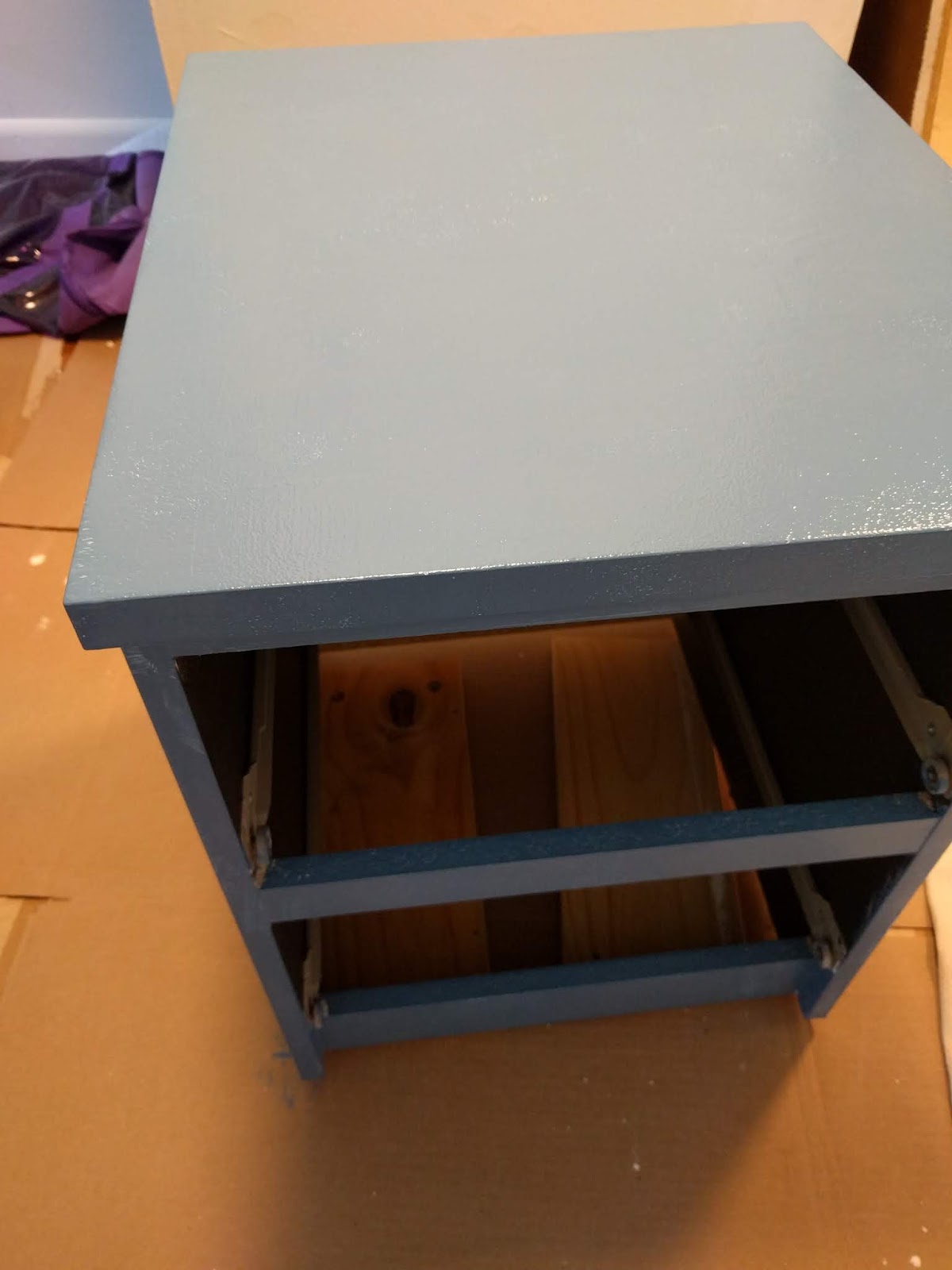
After one coat of Valspar 'Sea Swirl' (applied with a roller) I knew there would need to be a second coat. There were also a few sort of vague bubble-lumps that looked like they had been caused by the top getting wet. Maybe from too much primer?  Not super obvious, but visible in a certain light.  I didn't see anything similar in the drawer fronts or the sides.


After the second coat and the ready to proceed with hardware installation.


Here it is all staged in a corner, not where it will eventually live, but good for the photos.


Love the drawer pulls! They strike me as greek-key inspired.  Perhaps they will get a new shiny metal coating some day.

The total project-specific cost was approx $20, here is the break-down:

Primer, $12 (with plenty left over for future fun)
Paint sample, $5 (approx half a can left)
Drill and bits, already owned
Hardware, $0 ( freecycle salvage)

I had thought about adding some little legs to raise the height, but that would involve adding some wood to make a base. I have scrap wood, so this makeover might just have a sequel. Stay tuned!

Happy freestyling.