Showing posts with label garden. Show all posts

Sunday, January 3, 2021

Garden of freestyle delights - metal reflector

The Find

I like walking on nights other than trash night, but it is hard not to get excited about the prospect of finding new and interesting free things on trash night every week. For example, behold this random roll of thin metal. Whaaa? 

Roll of metal amongst other trash


What is this for? I have no idea what this roll of metal was originally used for, but I decided to combine it with some scrap wood and turn it into a light reflector for the garden.

The Making

The plan with this random roll of metal was to attach it to some scrap wood using a staple-gun, the same kind used in crafting or light-duty upholstering.  I unrolled the metal and held it down with a mix of clamps (only 0.99 at the hardware superstore), measured the width, and then cut with a pair of household scissors.  This probably dulled the scissors, but they are tools meant to be used.  I attached the bottom piece with staples, then repeated the process for the top piece - allowing for a slight overlap by the top metal piece, like shingles.

In progress: attaching the metal to the wood


Conclusion

I had enough of the thin metal to cover the entire piece of wood along with some leftover (perhaps for some future garden art?).  Here is the final piece "installed" in the garden (by leaning it against the railing and adding a cord around it so the wind won't blow it over) and hopefully reflecting light around a little bit more.

Metal light reflector in garden with pepper plants
Metal light reflector in garden behind ghost pepper plants


Happy freestyling and freestyle-inspired making, crafting, and constructing!

Sunday, December 27, 2020

Garden of freestyle delights - rusted metal plant stand makes a comeback in glossy black

The Find

Perhaps you can guess, but I don't even remember where I got this oddly shaped metal thing, some trash pile somewhere. It was a bit rusty, still solid (no breaks in the metal), and lightweight enough to carry easily. Naturally I took it home with me to see if it was what I thought it was.  Also, really, I just thought the shape was cool.

Rusty metal plant stand
Found: metal thing


Take a closer look and you can see that the metal had some significant rusty bits.  Luckily it seemed like all surface rust, nothing significant.

Close-up view of rusty spot on metal plant stand
Closeup of some rust


The Makeover

My initial thought was that the rounded ends of the metal would be a good fit under the lip of one of the standard pottery sizes.  I tested it on an adobe pot that I already had on hand, perfect fit!

Plant stand holding up adobe planter with thick rim
Proof! Metal thing fits a planter, perfectly


After determining that the metal would indeed serve as a plant stand, I decided upon a course of action. These courses of action are usually pretty simple: clean (sand), spray paint, use.


Metal planter receiving glossy black spray paint
Spray painting on some new glossy black


Conclusion

Now this once-forlorn and abandoned piece of metal has a new modish life as a plant stand.  In this case as a plant stand for a freestyled planter (once gray, now painted white) holding a lovely lush fern -- perfect as an air cleaner in a shady home.

Final product: glossy black metal plant stand holding planter with fern
Final product: Glossy black metal plant stand


Happy freestyle gardening and creating in whatever direction the freestyle path takes you!


Tuesday, December 8, 2020

Garden of freestyle delights - a round hayrack planter meets some hot pink mini chrysanthemums

The Find

While out and about for a walk I came across this tempting pile of garden giveaways. So neatly stacked up! Can you spot the black metal wire planter in the left stack? I took a few other things too...

Discarded garden supplies


The Fix

The round metal basket was very much in keeping with the style of some other finds and purchases sprinkled through the garden, including the first and second metal hayrack planters I found this summer.

I had to buy a slightly oversized coir insert because the superstore didn't have one that was an exact fit. I figured I could just fold in any excess, and I was right.

Conclusion

Wire metal planter with coir insert and hot pink mums.
Wire metal planter with coir insert and
hot pink mums.


One pot of dark pink mums was just the right size to fit inside of this freestyle find.

Happy freestyling, and don't be afraid to spend a few bucks to make that find beautiful!

Tuesday, October 13, 2020

Garden of freestyle delights - A cracked pot repair

The Find

A while ago I found this pot that was not just cracked, but also had a hole near the top.  

I took it anyway. 

Because free. Because planter. 

Broken unglazed pot sitting on yellow table
Broken unglazed pot


The Fix

In the same way that I fixed this large round pot with large cracks and this glazed green pot with multi-directional cracks, I decided to trust the fix to some 2-part epoxy.  I don't have a special applicator, I just used some small pieces of cardboard to mix the epoxy and then smear it on both sides of the crack.

Broken pot with epoxy applied


After I had applied the epoxy I let it dry and then got ambitious and wanted to scrap off some of the excess.  This caused the disturbed parts to turn white, normally the epoxy will dry clear, so I learned something new there.  Don't disturb the epoxy after it has started to dry!


Broken pot with epoxy dried, sitting on yellow table
Broken pot with disturbed epoxy, dried 


Although the cracks wind around quite a bit of the pot, they can still be hidden by turning the cracked side to the back.

Conclusion

I got some lovely hot pink snapdragons and decided they were the right scale of plant to use in this pot.  In order to prevent dirt from spilling out the hole I partially filled the pot with dirt, then placed a broken piece of pottery (found some months ago) on the inside of the pot, then added some more potting soil and the plant.

Pink snapdragons with repaired pot to be planted into
Snapdragons!


In order to prevent dirt from spilling out the hole I partially filled the pot with dirt, then placed a broken piece of pottery (found some months ago) on the inside of the pot, then added some more potting soil and the plant.

Top view of broken pot with dirt and ceramic shard
Potting soil and hole-blocking ceramic shard


From the side it looks like the broken pottery insert, although not a perfectly flush fit against the inside of the pot, it is blocking the dirt as intended.
Ceramic shard blocking hole in pot, outside view
Ceramic shard blocking hole, outside view


After I finished potting up the snapdragons everything looked great!  I didn't mind a bit of the epoxy showing, none of us are perfect.


Pink snapdragons in a newly repaired pot
Snapdragons in a newly repaired pot


Happy freestyling, don't be afraid to scavenge something and make it beautiful.

Tuesday, September 22, 2020

Garden of Freestyle Delights - Ornamental Ginger While Out for a Walk

The Find: Free Ornamental Ginger

While out for an evening walk I came across a very exciting sign in someone's yard next to the side of the road.  It said, " FREE ................. ORNAMENTAL GINGER" and there was a plastic bag with pieces of root inside.  I even took a picture for posterity.

Free ornamental ginger root, with sign


I let the root sit around for a few days until I acquired another set a free planters.  Spring is a good time for getting unwanted plastic (or broken ceramic) planters.


Stack of free plastic plant pots


Growing Ornamental Ginger


I planted the ornamental ginger in some potting soil, unsure if it would every sprout. Had I ignored it for too long? Had I planted it too shallow? Would it rot instead of revive? These are the doubts that plague a gardener. 

But plants can surprise you with their hardiness, at least this ornamental ginger root cutting did. 


First ornamental ginger sprout of red and green
First ornamental ginger sprout


And then it got a little taller....

Ornamental ginger sprout approximately 4inches tall


And then it got this tall and has stayed like that for a while!  I'm still waiting on flowers though...

Ginger plant and Clematis plant on staircase
Ornamental ginger co-planted with an impulse purchase clematis


In addition to the vertical growth (a.k. the plant's "habit" in the parlance of the horticultural world) I like the slight striping (variegation) of the leaves, which is visible in the photo below.

Close-up view of slightly variegated ginger plant leaf
Slightly variegated ornamental ginger plant leaf


Conclusion

When taking plant cuttings or roots, be aware of the risk of spreading invasive species or pests.  In this case the root cuttings were from the same neighborhood, and I was planning to grow the plant in an isolated container on a patio - not in the ground.  I'm not sure whether this plant would get taller if it were planted in the ground and could develop deeper roots, but that is not something I can experiment with right now!

Happy freestyle gardening, don't be afraid to scavenge for beauty!

Tuesday, August 4, 2020

Garden of freestyle delights - (another) scrap wood planter and a painting experiment

Upcycled Scrapwood into Painted Planter


When life gives you scrap wood, make scrap wood planters!  That has been my motto lately, and it has been fun to see what can be created out of a few leftovers by making as few cuts as possible.  The picture below is the bottom of the assembled planter while I was completing the last construction step -- drilling drainage holes into it. It's definitely made of leftover pieces, you can see someone else's pencil marks.

Bottom of scrap wood planter with drainage holes being drilled.


For this scrap wood planter I decided to try painting the outside with some really cheap poster paint.  The paint CLEARLY SAYS it is water-soluble, so I did not expect my paintings on the wood to last very long past the next rainstorm. But I was also curious about how much paint would sink into the wood and how long it might persist while living outside in the elements.

Here is the assembled planter before any painting.

Scrap wood planter and poster paint ready to use


I looked for some Art Deco inspiration, in the very loosest sense, and found a butterfly and a lotus - both of which seem like appropriate themes for garden art.  I have near-zero decorative painting skills, but this seemed like a good place to play around and try something new.

Painted Planter Results


I had 6 colors of the poster paint but didn't try to use them all, in this case simple was the goal.  

Below is the first side, painting inspired by an Art Deco jewelry piece I saw online.


Scrap wood planter painted with Art Deco butterfly motif

Below is the side that I painted with a lotus-inspired design. Van Gogh I am not, nor Monet.


Scrap wood planter painted with Art Deco lotus flower motif

Conclusion

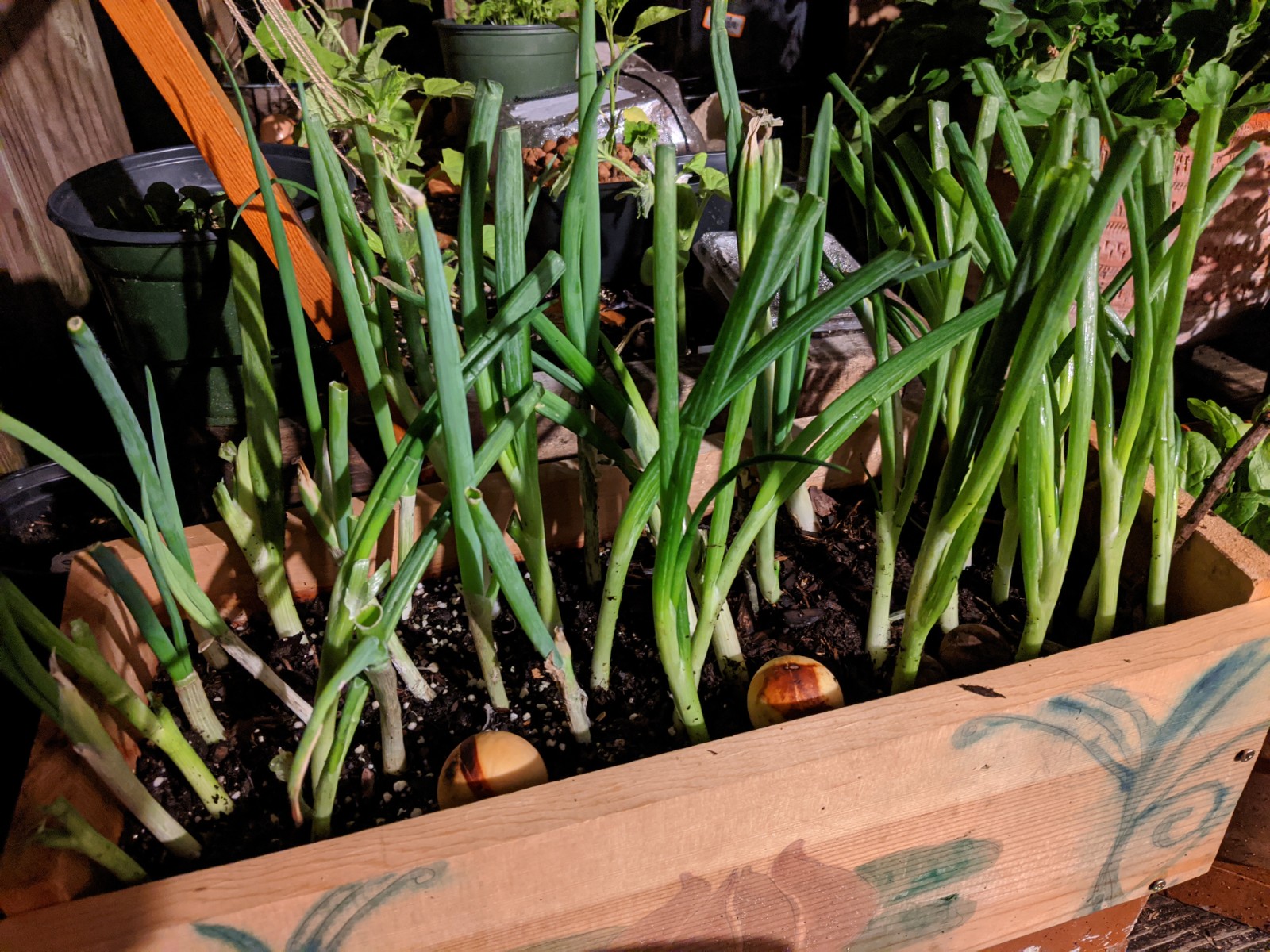
Lucky for this scrap wood planter painting experiment there was a rain event the very same night that I painted this planter and planted it with some scallions. (Yes, those are scallions purchased from the grocery store for 99 cents per bunch that I replanted in the garden.) The photos below shows how much washed away in that first rain event, just hours after the paint had dried.

Scrap wood planter with scallions and faded Art Deco lotus flower motif


Since the paint fades so quickly I wonder if this could be a technique to use if someone wanted to quickly create a 'weathered' look along new wood (it would be someone who had poster paint, but not other traditional aging washes like nails soaked in vinegar).  You could maybe use a mix of white, gray, brown, and black paint applications to mimic varied textures, let it sink into the wood and dry, and then wash the wood.  I have no idea if that would look reasonable or like a decrepit art project from some long-ago children's art attempt. 

This was a fun project, and all for the cost of a few screws and some $2 bottles of poster paint.  

Happy freestyle-garden-ing!


Tuesday, July 21, 2020

Garden of freestyle delights - Scrap wood tomato planter

Garden of freestyle delights

When you see a pile of scrap wood...

Does your mind automatically start calculating how big of a rectangle-ish box you could make? 

Seeing how pieces could be cut up, fit together, drilled through, and screwed into to make yet another thing that can hold dirt?

Well my mind was VERY MUCH in that space this spring when I had the urge to setup a patio garden space and try my hand at growing cherry tomatoes again. It's probably been a decade, but there is never a bad time to return to vegetable gardening!

The wood

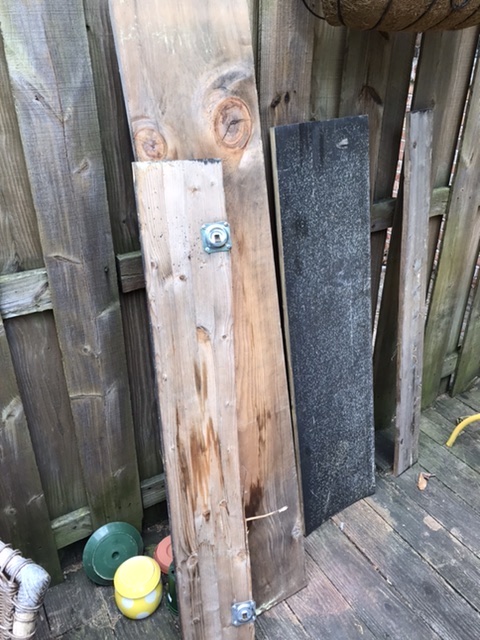
There was a pile of wood that was sitting abandoned for a while, which upon closer inspection turned out to be the remnants of a table. Some of the pieces had this lovely dappled silver pattern from the weathering.

Close-up image of weathered wood texture
Close-up of weathered wood


I have no idea if the wood was deliberately stained grey or if that was a reaction from being left outside. Either way, beautiful! 

Once we got all the pieces to the workspace the design of the planter started to come together a bit more, but first I had to take some pieces apart.  You can see the metal attachment plates for table legs in the picture below.

Pieces of scrap wood from abandoned table
Scrap wood from abandoned table


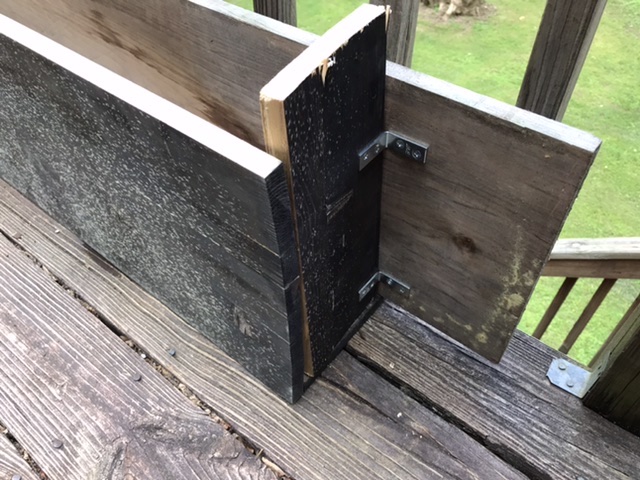
Luckily I didn't have to try to pry these off with my bare hands, I had a few tools available at this point. The power drill was essential in deconstructing any unwanted parts and then building the planter with the L-brackets that I bought from the hardware store.


Supplies used to construct the scrap wood planter, saw, drill, brackets
Saw, drill, and L-brackets


The planter

It is much easier to hold pieces in the proper alignment and screw them together with two people, so I'm glad I had a friend to help with this job.  There aren't any pictures of the sawing wood or actually screwing the pieces together with L-brackets, but here is what the basic box looked like when it was done.


Rectangular planter made from scrap wood

In case you are wondering, there is a reason the back wood cross-piece is longer than the front. Aside from trying to minimize the amount of hand-sawing needed for this project I wanted extra space to attached a trellis at some future point since my plan was to grow cherry tomatoes.

Below is a closeup of the end, you can see the L-brackets are on the outside here, because the inner space was simply too small to fit the drill.  You can also see that the front wood had bowed a bit, which is ok because this is a planter.

Scrap wood planter, short end with visible brackets
Planter end with visible L-brackets


From this top view you can see the L-brackets that were used on the inside of the planter box so that they wouldn't show from the font.  You can also see the drainage holes I drilled in the bottom using the largest available drill bit. Always always always consider the drainage!

Scrap wood planter from above with drainage holes visible
Planter from above with drainage holes visible


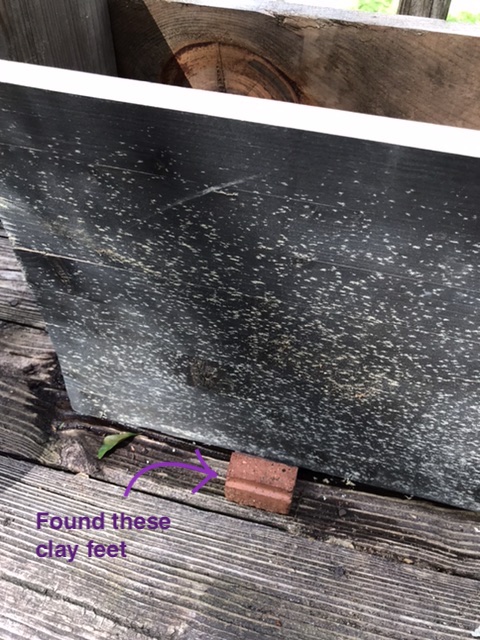
Part of thinking about drainage is looking at where your planter will be sitting. If a planter has drainage holes but is sitting on another surface that traps water then the situation can encourage mold or algae growth.  Similarly, a planter sitting on a wooden surface can trap moisture on top of the wood deck lead to unwanted effects.  So just like drainage, it is also important to consider ventilation and air flow.  In this case I proper up the planter a few inches on some ceramic feet that I had found in a give-away pile.


Scrap wood planter sitting on clay feet for elevation

There were only 3 ceramic feet so I had to space them carefully, but they held up to the weight just fine!  After getting the planter elevated and in the right position all that was left was to fill it with dirt and four tiny tomato seedlings.  For the cherry tomatoes I was limited to what was still available at the hardware store, and ultimately ended up with three 'supersweet 100 hybrid' strains and one 'black cherry tomato' strain.

Scrap wood planter with tomato seedlings


You'll notice in the above picture that there are peppers and rosemary plants attached to the railing above the cherry tomatoes.  I knew while building the tomato planter box that this garden arrangement would have to shift, and eventually I'd need to add a trellis or some sort of support for the tomatoes because I wanted to do string training.  An excellent description of why and how to do string training for tomatoes is available on this website.  Stay tuned for trellis and string-training updates in another post.


Conclusions

Rome wasn't built in a day, your garden doesn't have to be either.  In creating this freestyle garden the goal was to spend as little money (preferably no money) on large heavy objects like planters that won't be making the next move (whenever that happens).  This means keeping an eye out for free scrap wood, free ceramics whether largemedium, or small, and especially free plastic planters (way easier to carry than large pieces of wood).  See the potential!

Happy freestyling!

Tuesday, July 14, 2020

Garden of freestyle delights - metal hay rack planter

The Find

On a perfect spring evening I was out for a neighborhood walk and I can across a freestyle gardener's delight -- a bunch of freebies from someone who was clearly a serious gardener laid out on a lovely sweep of manicured lawn.

Gardening giveaways on trash night
So much potential


Part of me wanted to take it all, the grabby decorator crab part of me.  However, as I only had two hands and was for some silly reason already carrying a water bottle I had to limit myself. Treasure number one was obviously the metal trough (perfect for a fence!).  For treasure number two I was torn between the branch saw and some hedge clippers.  Since I don't have to maintain any trees around here I went with the hedge clippers since they were smaller (although probably heavier).

Metal + Coir = Lovely


These are the treasures after I got them home. There is a LOT of rust on those hedge clippers, which I still haven't cleaned off, but the main hinge still works and the handles are in good shape, so maybe I'll just leave that protective rust layer on the blades until I find I have a need to use them.  Anyway, the metal trough-looking thing is also known as a 'hay rack' or 'hayrack' planter because it looks like what you use to hold hay inside of a horse's stall.

Metal hayrack planter and rusty hedge clippers
Hayrack planter and hedge clippers


My friend was at first skeptical of this particular find (how do you hold the plants?).  But I explained that there were special liners for sale at the local hardware store and that this classic style would look luscious, but not messy, with trailing plants covering up the rusted spots.  So off I went to find a suitable sized liner made of coir (aka coconut fiber).  Lucky for me the local hardware store had one in just the right size.

Coir liner and metal hayrack planter
Planter and liner sitting pretty on a freestyle chair


Conclusion

I didn't want to drill holes through the fence, so instead I used some strong rope to hang the metal part from the top of the fence planks.  Then I placed the coir liner, filled it with potting soil, and added small wave petunia plants in shades of purple. I think the petunias were in 4" pots, I used three or four here.

Metal planter with purple wave petunias
Planted petunias 


Wave petunias are great for their repeated flowering and cascading 'wave' growth pattern, so I expected that it wouldn't take too long for them to grow over the front of the coir liner and soften the edge a bit.

The deep purple color is really lovely, here is a close-up in shot I took using a clip-on macro lens that fits over my cell phone camera.

Purple petunia flower center
Petunia center


Happy freestyling!

Tuesday, July 7, 2020

Garden of freestyle delights - Painted stone garden markers

Why you need garden markers

Optimistic gardeners might think they will remember where they planted such and such seeds, or which containers contain seeds. Hah.  Experience quickly teaches that it is easy easy easy to forget what you buried in the ground and where. Just ask any squirrel.  To help your memory, why not make some weather-proof garden markers?

How to make your own garden markers using rocks and acrylic paint

I had some luscious acrylic gold paint from a previous project where I was painting picture frames.  But nothing says gardens can't use a bit of bling! So I got out the paint and a pen, since I didn't have any paintbrushes at the time.


At first I tried to use the tip of the pen dipped in the acrylic to 'write' on the rocks by dragging the tip of the pen across the surface. This worked poorly on the uneven rock surface, the words were legible but the letter were uneven and blobby.  Then I thought about some painted rock mandala images I'd seen and thought about trying to using dots to make the letters. That worked out muuuuuch better, and also led to some other fun dot-based designs.  
Fair warning, this activity is addictive and soothing!

At the end of it I had some painted rocks with words for labeling the various seeds I had acquired to date: spinach, cilantro, and basil, along with some other freeform designs I could use for decoration while there was mostly bare dirt in the pots.


Conclusion

The easiest part is that you can just set the rock inside whatever pot you just planted up. No worries about it falling over or blowing away in a stiff breeze. Here is the garden label I made for some Thai basil seeds I got on sale because they were from last year.  Hope they germinate! Happy freestyling!


Update - the basil seeds took a long time to sprout, but they did eventually make it.

Sunday, June 28, 2020

Garden of freestyle delights - Planter for cucumbers

Garden of freestyle delights 

How a scrap wood planter came to be.

The evolution of a patio from a nondescript outdoor space into a garden during this time of quarantine has been a welcome relief. Projects provide purpose. Gardening is known to be therapeutic, and for me, an extra layer of joy is added when the creation of a garden becomes a cross between a freestyle treasure hunt and impulse plant-buying.  In these 'Garden of freestyle delights' posts I'm going to describe different projects that have been part of this garden evolution.
If this space had all been planned - as a whole - from the beginning it would probably look much different and be worthier of Monty Don's approval. As it is, I hope he would appreciate the spirit, the creative reuse, and the adventure of how it has evolved so far. So let's get into it.

It started with finding some free pots set out on recycling night, like these.....


3 gallon black plastic plant pot
Sturdy black plastic pot
Maroon hanging ceramic pot, sitting upside-down
Maroon ceramic hanging pot, upside-down


...and for a while it stayed quite modest.  
A few modest plants hanging out, waiting to see if they would get destroyed by insects, or birds, or the cat. 


Just a few pots on the edge of the patio. 
Nothing special. 
Hardly even noticeable.....


Then I got access to power tools and a whole new world of possibility opened up.
This meant that not only could I use freestyle planters (plastic, ceramic, etc) for gardening, but I could use freestyle scrap wood to MAKE MY OWN PLANTERS!!!!!  

Depending on where you live and the time of year there may or may not be lots of scrap wood out on the sidewalk. But let me tell you, in a warm-weather climate, during a time that coincided with spring cleaning AND a quarantine where people are at home AND beautiful weather for home renovations....
....yeah, there has been a lot of scrap wood out for free.

 If I had a truck to pick it up and a giant lawn I could make raised beds for days. But, as things stand I am mostly only taking what I can carry.  But I digress, let me return to the cucumber box.  I found a slightly rotting wooden table very close to the patio, and convinced a friend to help me move it. In my excitement I didn't take a 'before' picture. But it had two boards across the top, and two rectangles made of 2x4s for legs.


Construction

I realized that I could flip the setup of the existing table, use the table top as a base, and use the leg rectangles - stacked one on top of the other - as the sides for a planter.  I wouldn't even have to make any cuts with my glamorous hand saw.

Here is what the wooden pieces looked like after I removed the legs from the 'table top' pieces and laid them out to see what the planter would look like.  My plan was to secure the rectangles to each other, and secure the lower rectangle to the wooden base pieces using metal L-braces (purchased from a hardware store, using money).


I even saved the screws that I pulled out in case there was a way to reuse them. They were very rusty.


Remember how I mentioned that the table was 'slightly rotting'? Yeah, well, it has clearly been sitting outside for weeks (multiple months?), and there were mushrooms growing in the cracks. 
I took it as a good sign.


Here is the planter box after assembly and placement in the corner of the patio.  If this box were going to be moved often I would add a few more braces and brackets between the different parts, but the current plan is to use this for only one season.


You might notice that the planter box seems to be elevated off the deck. Good eye!  I didn't want the wooden base of the box to be sitting directly on the decking, so I stacked up some pieces of polystyrene to use as 'legs'.  I figured this setup would allow for airflow and better drainage. If polystyrene will last 10,000 years before degrading, then those legs should be able to handle the warm and rainy weather here!


The final step before adding the potting soil was to drill some more drainage holes in the base.  The two flat base pieces already had a slight gap between them from being warped and weathered, but I wanted more drainage. Drainage drainage drainage and no worries about rotting roots.


Since cucumbers are vining plants I wanted to add a trellis. Obviously I did not want to pay for a trellis.  In classic scavenged freestyle beauty fashion I found this pieces that appeared to be an old children's art easel out for the taking. I actually walked by it (along with various other discarded wood pieces) for a few nights before being able to pick it up using a friend's car (separate story there about looking for trellis supplies).  I took apart the V-shaped easel and used one half of it as a trellis base for these cucumber plants. The easel piece was just the right width to fit across the width of the planting box and to sit on top of the little shelf created by the long table-top-turned-planter-bottom pieces.  To give the cucumbers something to climb I added twine strings tied at the top, wrapped around each cross piece on their way down, and tied to another cross-piece of twine at the base. 


Conclusion

There you have it, a freestyle scavenged scrap wood planter box and trellis. The only costs for this project were the L-shaped brackets, the twine, the potting soil, and some small cucumber seedlings -- all from the hardware store.  Check back for other posts about creating a garden on the freap (free+cheap).

Happy freestyling and gardening.

"He that plants trees loves others besides himself."
--Thomas Fuller