Showing posts with label reuse. Show all posts

Tuesday, April 4, 2023

Beehivey Ribbed Planter Makeover

The Freestyle Find

Those who (successfully) garden indoors eventually face the dilemma of plants that outgrow their pots.  At first the solution is obvious, just get a bigger pot, and for pots below the 6-7-inch diameter range this usually isn't too expensive.  The Swedish superstore has a wide variety, and I'm an owner of various sizes of PAPAJA and MUSKOT-series plant pots.  However, larger and larger ceramics also get heavier and heavier (especially when filled with associated plant material) so at some point it makes weight-sense to switch to some type of plastic outer pot. The problem I have is that lots of plastic pots are ugly and so very plastic-looking and more expensive than the $0 I want to spend on plastic.  Lucky for me I came across this planter that was free, large, and interestingly-shaped-but-ugly-color and thus was crying out for a makeover.  I washed it in the tub and after it dried I got to work painting, and oops I forgot to take a full-size 'before' picture.

Pea green plastic planter close-up view


The Makeover

I knew right away that the makeover for this plastic cachepot would be simple and quick, transform the stained pea-green exterior with some matte white paint so that the planter would blend in with my existing collection.  This process started with some primer (this gallon of primer just keeps on giving, I've been using it for 5 years now).....

Pea green plastic planter halfway covered with white primer
In-progress, applying primer to plastic


....and the process continued with some **free** paint+primer in the form of a quarter-full can that I received from a neighbor, the color was Behr Ultra Pure White 2050 in Interior Eggshell Enamel. I'm wasn't sure what sort of sheen 'eggshell enamel' would have, because eggshell sounds 'not-shiny' and enamel sounds 'shiny'.  All coatings were applied with a low quality chip brush.

Behr Paint-plus-primer product can, color Ultra Pure White, in front of the painted planter
Paint can in front of the painted planter


Conclusion

The final result of the multiple coats was a lovely matte white color that shows off the cool ribbed texture while serving as a backdrop for a tall dark green Sansevieria plant (aka Snake Plant).  This might not be the last plastic cachepot that gets this paint treatment.


Close-up of Sansevieria plant in ribbed white plastic planter
A closer view of the painted planter.


Below is a full-length view of the Sansevieria in its new home.  The contrast of the bulbous beehive-shape planter with the strong vertical lines of the plant is just what I was hoping for.

Sansevieria plant in ribbed white plastic planter
Sansevieria plant in a new home.


Happy freestyling, if the item is free why not paint it?  Give it a go.

Tuesday, August 4, 2020

Garden of freestyle delights - (another) scrap wood planter and a painting experiment

Upcycled Scrapwood into Painted Planter


When life gives you scrap wood, make scrap wood planters!  That has been my motto lately, and it has been fun to see what can be created out of a few leftovers by making as few cuts as possible.  The picture below is the bottom of the assembled planter while I was completing the last construction step -- drilling drainage holes into it. It's definitely made of leftover pieces, you can see someone else's pencil marks.

Bottom of scrap wood planter with drainage holes being drilled.


For this scrap wood planter I decided to try painting the outside with some really cheap poster paint.  The paint CLEARLY SAYS it is water-soluble, so I did not expect my paintings on the wood to last very long past the next rainstorm. But I was also curious about how much paint would sink into the wood and how long it might persist while living outside in the elements.

Here is the assembled planter before any painting.

Scrap wood planter and poster paint ready to use


I looked for some Art Deco inspiration, in the very loosest sense, and found a butterfly and a lotus - both of which seem like appropriate themes for garden art.  I have near-zero decorative painting skills, but this seemed like a good place to play around and try something new.

Painted Planter Results


I had 6 colors of the poster paint but didn't try to use them all, in this case simple was the goal.  

Below is the first side, painting inspired by an Art Deco jewelry piece I saw online.


Scrap wood planter painted with Art Deco butterfly motif

Below is the side that I painted with a lotus-inspired design. Van Gogh I am not, nor Monet.


Scrap wood planter painted with Art Deco lotus flower motif

Conclusion

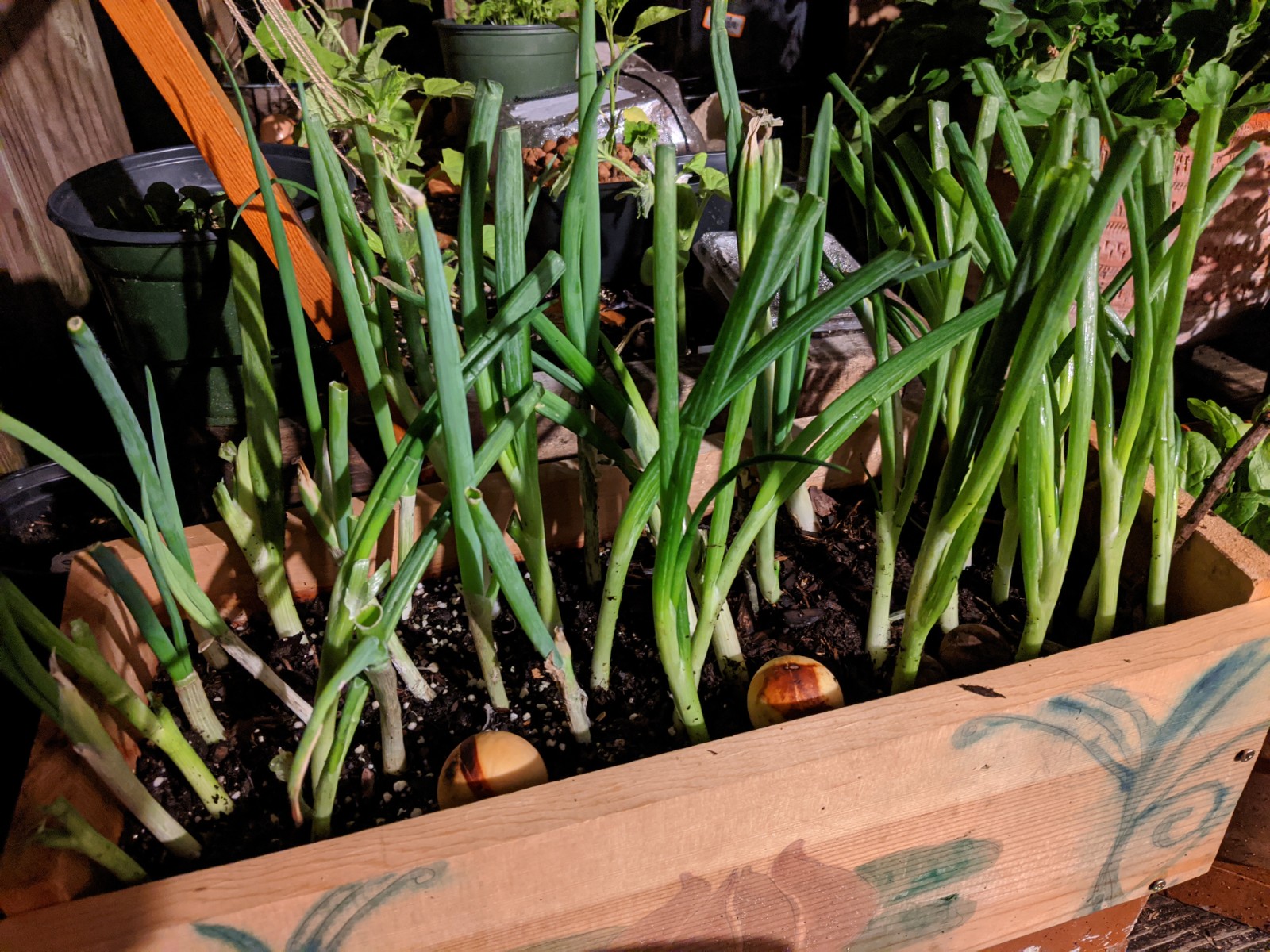
Lucky for this scrap wood planter painting experiment there was a rain event the very same night that I painted this planter and planted it with some scallions. (Yes, those are scallions purchased from the grocery store for 99 cents per bunch that I replanted in the garden.) The photos below shows how much washed away in that first rain event, just hours after the paint had dried.

Scrap wood planter with scallions and faded Art Deco lotus flower motif


Since the paint fades so quickly I wonder if this could be a technique to use if someone wanted to quickly create a 'weathered' look along new wood (it would be someone who had poster paint, but not other traditional aging washes like nails soaked in vinegar).  You could maybe use a mix of white, gray, brown, and black paint applications to mimic varied textures, let it sink into the wood and dry, and then wash the wood.  I have no idea if that would look reasonable or like a decrepit art project from some long-ago children's art attempt. 

This was a fun project, and all for the cost of a few screws and some $2 bottles of poster paint.  

Happy freestyle-garden-ing!


Tuesday, July 21, 2020

Garden of freestyle delights - Scrap wood tomato planter

Garden of freestyle delights

When you see a pile of scrap wood...

Does your mind automatically start calculating how big of a rectangle-ish box you could make? 

Seeing how pieces could be cut up, fit together, drilled through, and screwed into to make yet another thing that can hold dirt?

Well my mind was VERY MUCH in that space this spring when I had the urge to setup a patio garden space and try my hand at growing cherry tomatoes again. It's probably been a decade, but there is never a bad time to return to vegetable gardening!

The wood

There was a pile of wood that was sitting abandoned for a while, which upon closer inspection turned out to be the remnants of a table. Some of the pieces had this lovely dappled silver pattern from the weathering.

Close-up image of weathered wood texture
Close-up of weathered wood


I have no idea if the wood was deliberately stained grey or if that was a reaction from being left outside. Either way, beautiful! 

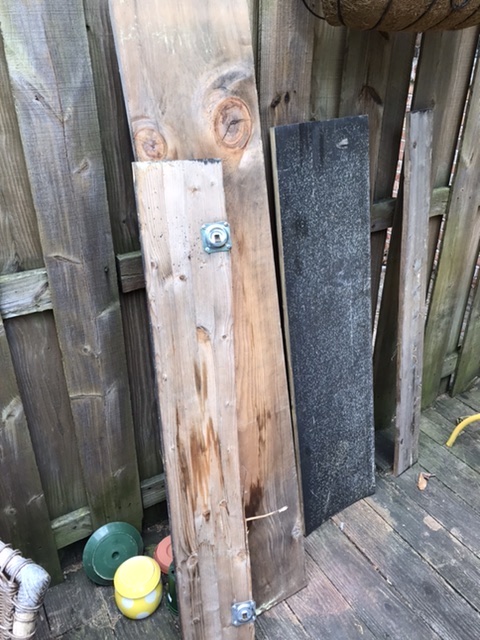
Once we got all the pieces to the workspace the design of the planter started to come together a bit more, but first I had to take some pieces apart.  You can see the metal attachment plates for table legs in the picture below.

Pieces of scrap wood from abandoned table
Scrap wood from abandoned table


Luckily I didn't have to try to pry these off with my bare hands, I had a few tools available at this point. The power drill was essential in deconstructing any unwanted parts and then building the planter with the L-brackets that I bought from the hardware store.


Supplies used to construct the scrap wood planter, saw, drill, brackets
Saw, drill, and L-brackets


The planter

It is much easier to hold pieces in the proper alignment and screw them together with two people, so I'm glad I had a friend to help with this job.  There aren't any pictures of the sawing wood or actually screwing the pieces together with L-brackets, but here is what the basic box looked like when it was done.


Rectangular planter made from scrap wood

In case you are wondering, there is a reason the back wood cross-piece is longer than the front. Aside from trying to minimize the amount of hand-sawing needed for this project I wanted extra space to attached a trellis at some future point since my plan was to grow cherry tomatoes.

Below is a closeup of the end, you can see the L-brackets are on the outside here, because the inner space was simply too small to fit the drill.  You can also see that the front wood had bowed a bit, which is ok because this is a planter.

Scrap wood planter, short end with visible brackets
Planter end with visible L-brackets


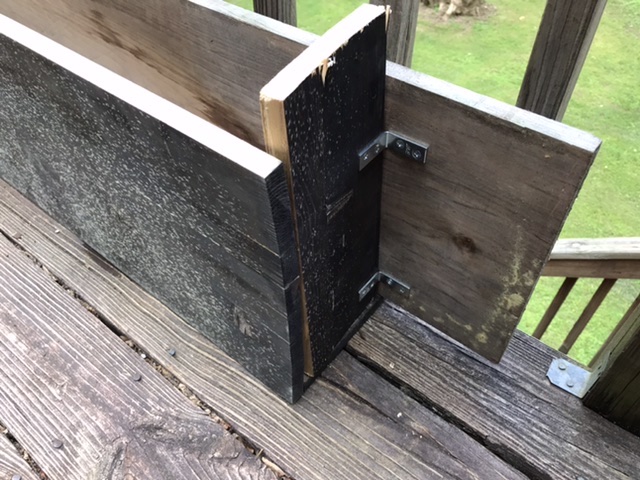
From this top view you can see the L-brackets that were used on the inside of the planter box so that they wouldn't show from the font.  You can also see the drainage holes I drilled in the bottom using the largest available drill bit. Always always always consider the drainage!

Scrap wood planter from above with drainage holes visible
Planter from above with drainage holes visible


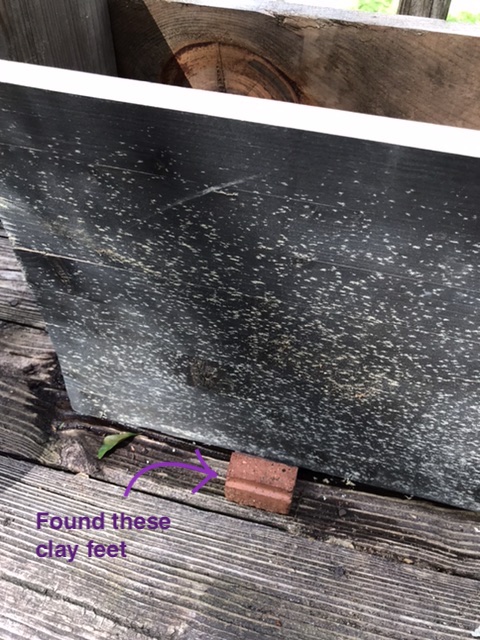
Part of thinking about drainage is looking at where your planter will be sitting. If a planter has drainage holes but is sitting on another surface that traps water then the situation can encourage mold or algae growth.  Similarly, a planter sitting on a wooden surface can trap moisture on top of the wood deck lead to unwanted effects.  So just like drainage, it is also important to consider ventilation and air flow.  In this case I proper up the planter a few inches on some ceramic feet that I had found in a give-away pile.


Scrap wood planter sitting on clay feet for elevation

There were only 3 ceramic feet so I had to space them carefully, but they held up to the weight just fine!  After getting the planter elevated and in the right position all that was left was to fill it with dirt and four tiny tomato seedlings.  For the cherry tomatoes I was limited to what was still available at the hardware store, and ultimately ended up with three 'supersweet 100 hybrid' strains and one 'black cherry tomato' strain.

Scrap wood planter with tomato seedlings


You'll notice in the above picture that there are peppers and rosemary plants attached to the railing above the cherry tomatoes.  I knew while building the tomato planter box that this garden arrangement would have to shift, and eventually I'd need to add a trellis or some sort of support for the tomatoes because I wanted to do string training.  An excellent description of why and how to do string training for tomatoes is available on this website.  Stay tuned for trellis and string-training updates in another post.


Conclusions

Rome wasn't built in a day, your garden doesn't have to be either.  In creating this freestyle garden the goal was to spend as little money (preferably no money) on large heavy objects like planters that won't be making the next move (whenever that happens).  This means keeping an eye out for free scrap wood, free ceramics whether largemedium, or small, and especially free plastic planters (way easier to carry than large pieces of wood).  See the potential!

Happy freestyling!

Saturday, June 13, 2020

Garden of Freestyle Delights - Hanging Garden Using Leftover Mesh Produce Bags

Mesh of a bag

Single use plastics are generally bad, and yet really hard to avoid.  One specific type of single-use plastic that seems ripe for re-use is the open-weave mesh produce bag. You know the one I'm talking about. They look like discarded fishing gear (big problem, separate topic) but contain something delicious like avocados, oranges, or onions.  To open the bag to get at the delicious delicious food you usually have to cut or rip open the plastic mesh, leading to plastic bag bits everywhere. Then what to do with this meshy mess? Can it avoid immediate transportation to 10,000 years of landfill time?

The idea

At some point a dim dim lightbulb went off in my head and I realized that if these mesh bags were rated to hold 3 or 5 pounds of produce they could also be used to HOLD PLANTS AS HANGING PLANTERS.  So. Obvious.  I just had to see if I could get rid of the labels without destroying the mesh.
Here is an example of what I started with.

Citrus produce bag on yellow chair
Produce bag about to start a new life


Hanging garden of (something that was) eaten

After accumulating a few produce bags (shockingly quickly) I carefully removed the labels. Some brands have large labels that are just a tag on top (nicer for this project), and others like this citrus bag have big colorful plastic labels that are bonded along the whole length of the mesh. I'm sure there is a reason for this related to processing efficiency, but this style was much harder to remove without either leaving little bit of the label on the mesh, or tearing the mesh.  Good thing it was free.  Below is an example of what I ended up with.

 
Plastic mesh bag with label removed
Mesh bag post label removal


I had saved a set of four small hooks from some trash pile (I think they are the kind usually used to hold an over-the-door mirror if I had to guess) and they were the perfect size to fit over the fence cross pieces.  However, you could also use some string or twine to suspend these from a hook. I had some small planters that fit stably into the mesh and hung them up along the fence. Simple as can be.  The cut ends of the mesh were a little messy looking, so I gathered and folded the edges in a bit to make it look neater.  In case you're curious the plants are from left to right: begonia seedling, zinnias growing from seed, begonia seedling, nasturtiums growing from seed. If you're going to use your own mesh produce bags I'd suggest using square plastic containers instead of round ones, because you can poke the corner through the holes in the mesh to help secure the plant pot a little better.  Maybe this only matters if the hanging garden will be subject to gusts of wind. I think the blue bags came from onions, and the orange bags were from citrus purchases.  

Four mesh hanging bags with plants
Hanging garden, no tools required


So that's my first attempt at making a hanging garden out of leftover mesh produce bags. It keeps smaller containers away from foot traffic and adds some plant love to this awkward fence section.

Happy freestyling, and don't be afraid to experiment to make your own scavenged beauty garden setup!

Tuesday, April 26, 2016

From polluter to air purifier (indoor gardening DIY tutorial)

DIY Tutorial : How to make a cachepot from an old candle

As I was walking by the dumpsters one night, y'know like any common person, I saw this basket of stuff off to the side.  Why didn't I take the basket too??  I was clearly too distractedly excited about finding the two candles inside.  You can see there were two, one blue, one white.


Here are the two candles in my sink, waiting to be cleaned out.


I'm not a candle person to begin with, and those things smelled STRONG. Like crazy perfume strong, no way was I going to keep them around.  I couldn't wait to get the wax out and start the transformation into pretty glass cachepots.

Using a flat screwdriver I was able to break the wax into a few sections and then just flip it out.  It was a little trickier in the blue glass jar because the lip was narrower than the base.After getting the visible wax out I ran the glass through the dishwasher to try to remove the smell and soften up the glue that was attaching the wick to the base. Getting the wick removed from the bottom took a few minutes because it was hard to get a grip on it with the waxy covering that remained. Patience prevailed in the end.

You can see I accidentally scraped the paint in a few places, but its not obvious if you are looking at it from the outside, only when light is shining through from the outside. 


I had another Haworthia succulent that needed a new home, so I cut down a coffee cup to match the height of the blue glass and poked a few holes in the bottom for drainage.


It was just that simple! Voila, a fancy free cachepot saved from the trash pile.


To recap, here are the DIY tutorial steps to make a cachepot from an old candle:

1. find old candle

2. using a flat screwdriver carefully poke through the wax down to the glass and cut the wax up into pieces.

3. Using the screwdriver as a lever, lift out the wax pieces and discard (unless you can think of a great way to reuse candle wax, maybe to wax a sticky drawer slide?)

4. If the wick is glue to the base of the candle try to pry it up with the screwdriver, it may take a few minutes of prying and gently pulling on the wick with your fingers. Keep a paper towel around to wipe off the wax as needed.

5. After you have removed all the wax, wash the glass jar

6. Insert new plant, either directly into glass or via a smaller planter set inside.

Happy freestyling and indoor gardening!